

Why hospitality needs practical reuse systems, not just sustainability promises

Sustainability has become a familiar part of hospitality language.
Hotels talk about environmental commitments. Brands highlight greener choices. Guests increasingly expect businesses to show some awareness of waste, resources, and long-term impact. On the surface, that is a positive shift. But in practice, there is still a gap between what sounds good and what actually works.
That gap matters.
Because in hospitality, sustainability is not just a messaging issue. It is an operational one. A hotel can make broad commitments, introduce better policies, or talk about reducing waste, but if the systems behind those goals do not fit the reality of day-to-day service, the result is often inconsistency rather than change.
That is why hospitality does not just need sustainability promises. It needs practical reuse systems.
This is especially true when it comes to one of the most visible and repetitive parts of hotel operations: bottled water.
Water moves through guest rooms, restaurants, service areas, events, and daily housekeeping routines. It is consumed constantly, restocked constantly, and often treated as a background necessity rather than a strategic part of operations. But because it is so routine, it is also one of the clearest places where operational systems matter.
The question is not simply whether one bottle looks greener than another. The real question is whether the system around that bottle is workable.
Can it fit into hospitality standards? Can it move through supply and service in a reliable way? Can it be integrated into daily operations without creating unnecessary friction for hotel teams? Can it support a real reduction in single-use plastic, rather than just offering a better-looking alternative?
Those are the questions that matter.
In many sustainability conversations, the focus remains too heavily on product choice alone. That can be useful up to a point, but hospitality rarely succeeds through one-off swaps or standalone gestures. It succeeds through systems: systems of procurement, storage, service, replenishment, housekeeping, back-of-house handling, and guest-facing consistency.
If a sustainability initiative does not work inside those systems, it is unlikely to hold up over time.
That is one of the reasons practical reuse models are so important.
A reuse system asks a different question from a single-use product. It is not just about what material is used once. It is about whether the item can remain part of an ongoing loop. That means collection, cleaning, inspection, refill, return, and repeat use all become part of the operational model. And in hospitality, that shift matters because it changes the conversation from disposal to continuity.
For hotels, continuity is everything.
Guest experience depends on consistency. Back-of-house systems depend on reliability. Stock handling depends on routines that staff can repeat without confusion. Sustainability in hospitality cannot sit outside those realities. It has to fit inside them.
That is where practical systems become more valuable than broad promises.
A promise may help shape intent. A system is what makes implementation possible.
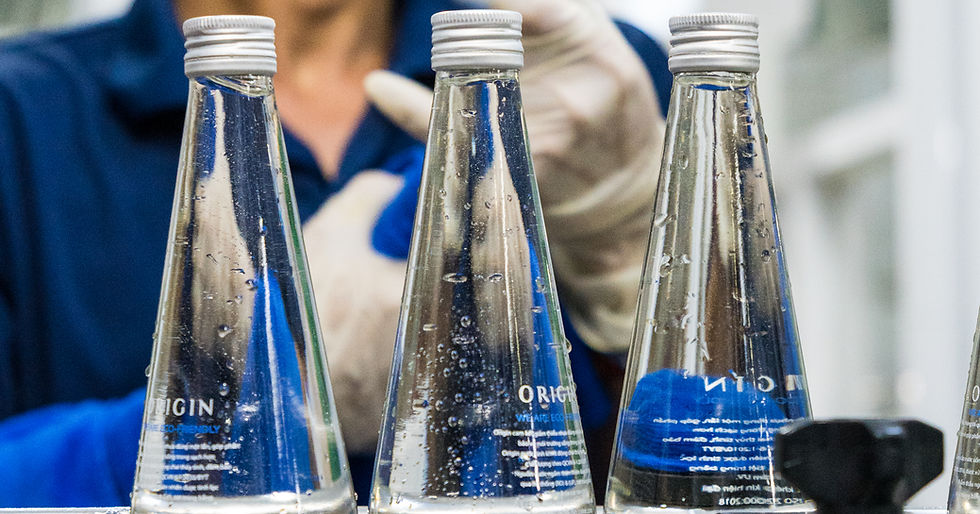
For Origin Water Phú Quốc, that distinction is central. Origin’s model is not built around asking hospitality businesses to support a sustainability idea in theory. It is built around providing a closed-loop glass bottled water system that is designed to work in real operations.
Based in Phú Quốc and operating locally, Origin works primarily with hotels and, to a smaller extent, restaurants. The model is straightforward: bottles are delivered for use, collected once empty, brought back to the factory, cleaned, sterilised, inspected, refilled, resealed, packed, and delivered again.
What matters is not just that this sounds more sustainable. What matters is that it functions as a repeatable local system.
That repeatability is what hospitality needs.
Hotels do not need solutions that depend on unusual effort every time. They need systems that can become part of normal workflow. They need supply that is dependable. They need service models that staff can understand and repeat. They need solutions that align with operational standards rather than disrupt them.
That is why the phrase “practical sustainability” matters so much more than polished sustainability language.
The hospitality sector does not benefit from promises alone. It benefits from models that can be used, managed, and sustained over time.
This is also why local context matters.
In a place like Phú Quốc, sustainability cannot simply be imported as a concept. Island conditions shape logistics, supply, waste challenges, and the relationship between tourism and the local environment. A system that works well in one place may not automatically work in another. That makes locally built and locally managed approaches more relevant.
Origin’s model is grounded in those realities. It is designed around the conditions of the place it serves, not just the image it wants to project.
That local grounding is important because hospitality sustainability often becomes too detached from place. It can drift into general language that sounds credible but feels interchangeable. What gives a system value, however, is not just the message. It is whether the system is useful to the businesses actually operating there.
For hotels, a practical reuse system offers something more meaningful than a surface-level signal. It offers a way to reduce reliance on single-use plastic through an operational model that can be repeated every day.
That is where change starts to become real.
Not because a business makes one statement or replaces one product, but because it supports a system that keeps working. Day after day. Delivery after delivery. Room after room. Service after service.
This is a quieter kind of progress than many marketing campaigns promise, but it is often the more valuable kind. Hospitality does not need every solution to be dramatic. It needs solutions that can hold up under the pressure of actual operations.
That is what reuse systems offer when they are built well.
They move the conversation away from appearance alone and towards infrastructure, discipline, and process. They make sustainability less about what is said, and more about what is sustained.
For a destination like Phú Quốc, that matters. Tourism and environment are deeply connected. The long-term value of hospitality depends, in part, on the quality of the place itself. If businesses want to reduce plastic in a meaningful way, the answer is not only better messaging. It is better systems.
Hospitality needs practical reuse systems because good intentions are not enough on their own.
They may begin the conversation, but systems are what carry it forward.
Follow the journey to see how practical local models can support a more workable approach to hospitality on Phú Quốc.


Comments